Learning how to parallel park is one of the most important skills every driver must master, yet it is also one of the most misunderstood. Many learners approach it with anxiety, assuming it requires perfect timing or special talent, but in reality, parallel parking is a structured technique built on positioning, observation, and controlled movement. Once you understand how the process works and practice it consistently, it becomes a natural part of driving rather than a stressful challenge. Whether you are preparing for a driving test or navigating crowded city streets, knowing how to parallel park correctly gives you independence and confidence in situations where space is limited and precision matters most.
At its core, parallel parking is about fitting your car smoothly into a space between two parked vehicles along a curb. Unlike regular parking, you are not entering head-on but reversing into position using a controlled turning motion. This requires awareness of your surroundings, careful use of mirrors, and an understanding of how your car moves as you turn the steering wheel. Many drivers struggle because they try to memorize steps without understanding the logic behind them, but when you grasp the underlying concept, the process becomes far easier to adapt in different situations, whether the space is large, tight, or slightly uneven.
Understanding the Fundamentals Before You Begin
Before attempting how to parallel park, it is essential to understand a few key principles that make the maneuver predictable and manageable. The first is space judgment, which involves selecting a parking spot that comfortably fits your vehicle. Ideally, the space should be at least one and a half times the length of your car so you have enough room to maneuver without forcing tight angles. Beginners often choose spaces that are too small, which increases pressure and makes the process unnecessarily difficult. Starting with larger spaces helps build confidence and allows you to focus on technique rather than stress.
Another critical factor is positioning your vehicle correctly before you begin reversing. The distance between your car and the parked vehicle next to you should be consistent, usually about a door’s width. If you are too close, you risk scraping the other car, and if you are too far, your turning angle will not allow you to enter the space smoothly. Equally important is speed control, as parallel parking should always be done slowly and deliberately. Moving at a controlled pace gives you time to observe, adjust, and react to any obstacles or changes in your surroundings.
Step-by-Step Process to Parallel Park Correctly
To understand how to parallel park effectively, imagine the maneuver as a smooth, continuous motion rather than a series of rushed steps. First, identify a suitable parking space and signal your intention early so other drivers are aware of your plan. Pull up alongside the vehicle in front of the empty space, keeping your car parallel and aligned with it. Your rear bumper should roughly match the rear bumper of the parked car, as this alignment sets the correct starting point for your turn.
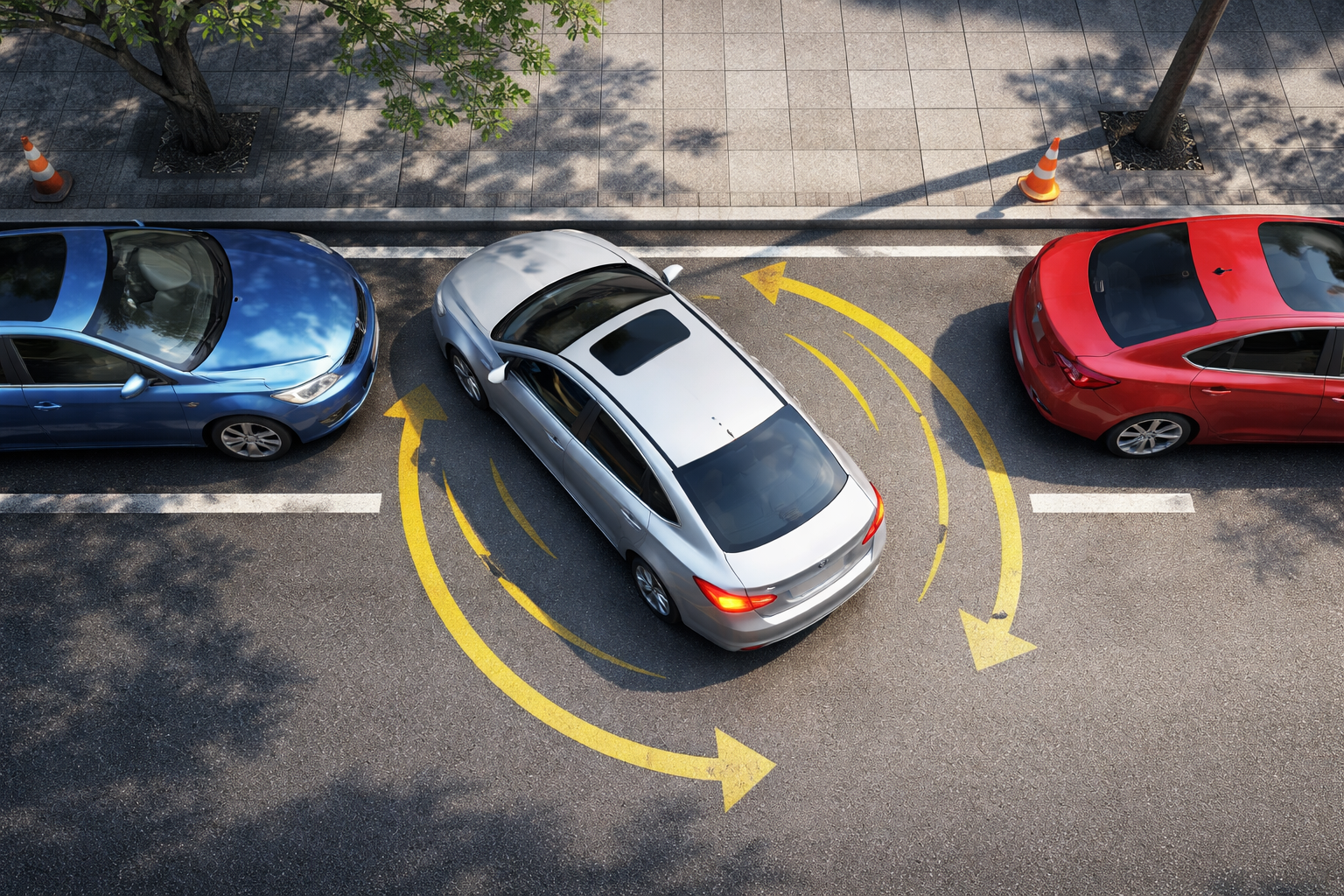
Once positioned, shift into reverse and begin moving slowly while turning the steering wheel fully toward the curb. This initial turn allows the rear of your vehicle to enter the space at an angle. As your car moves backward, keep checking your mirrors and surroundings to ensure you maintain a safe distance from both the curb and nearby vehicles. When your car reaches a diagonal position and your front clears the rear of the vehicle ahead, you should straighten the steering wheel briefly before turning it in the opposite direction. This second turn brings your car fully into the space and aligns it parallel with the curb.
After entering the space, you may need to make small adjustments by moving forward or backward to center your vehicle between the cars. The goal is to leave enough room for both vehicles to exit comfortably while keeping your car close enough to the curb without touching it. Straighten your wheels once you are satisfied with your position, and ensure your vehicle is securely parked. With practice, these movements become fluid and instinctive rather than mechanical.
The Logic Behind the Movement
Understanding how to parallel park becomes much easier when you recognize that the maneuver follows a natural curved path. Instead of thinking of it as separate steps, imagine your car tracing an S-shaped motion as it enters the space. The first curve brings the rear of the car toward the curb, and the second curve straightens the vehicle into alignment. This concept explains why timing is so important, as turning too early or too late disrupts this smooth path and makes it harder to fit into the space.
This geometric approach also helps you adapt to different situations. For example, if the parking space is tighter than usual, you may need to adjust your turning angle slightly or move more slowly to maintain control. If the space is larger, you have more room for correction, which can make the process easier. By focusing on the flow of movement rather than rigid steps, you gain the flexibility needed to handle real-world parking scenarios.
Common Challenges and How to Overcome Them
Many drivers face similar challenges when learning how to parallel park, and recognizing these issues early can help you improve faster. One common problem is misjudging distance from the curb, which can result in either being too far away or accidentally hitting it. Using your side mirrors effectively can help you gauge this distance more accurately and maintain proper alignment throughout the maneuver.
Another frequent difficulty is turning the steering wheel at the wrong moment. Timing is critical, and even a slight delay or early turn can affect your final position. Practicing in a quiet area allows you to develop a sense of timing without the pressure of traffic. It is also important to avoid rushing, as moving too quickly reduces your ability to make precise adjustments and increases the risk of mistakes.
Some drivers rely too heavily on one mirror or ignore blind spots, which can lead to unsafe situations. Developing a habit of checking all mirrors and briefly looking over your shoulder ensures you remain aware of your surroundings at all times. Confidence comes from combining observation with controlled movement, not from speed or guesswork.
Adapting to Tight Spaces and Busy Streets
As you gain experience, you will encounter situations where parking spaces are smaller or traffic is heavier. Knowing how to parallel park in these conditions requires greater precision and patience. In tighter spaces, it is important to focus on smaller, more controlled steering inputs rather than full turns. This allows you to fine-tune your position and avoid overcorrecting.
In busy areas, communication becomes just as important as technique. Using your indicators early and clearly signals your intention to other drivers, reducing confusion and giving you the time needed to complete the maneuver safely. Staying calm under pressure is essential, as anxiety can lead to rushed decisions and mistakes. Remember that it is acceptable to take your time as long as you are aware of traffic and acting responsibly.
Parallel Parking During a Driving Test
For learners, demonstrating how to parallel park during a driving test can feel intimidating, but examiners are primarily looking for control, awareness, and safety. You do not need to execute the maneuver perfectly in one attempt, as small corrections are usually allowed if done safely. The key is to show that you understand the process and can maintain control of the vehicle throughout.
Remaining calm and focused is crucial during the test. Nervousness often leads to rushed movements or hesitation, both of which can affect your performance. Practicing regularly in different environments helps you build the confidence needed to perform well under test conditions. By the time you take the test, parallel parking should feel like a familiar routine rather than a difficult task.
Real-World Practice and Skill Development
The transition from learning how to parallel park to mastering it comes through consistent practice in real-world conditions. Starting in quiet areas allows you to focus on technique without distractions, while gradually moving to busier streets helps you adapt to realistic scenarios. Practicing with different vehicle sizes can also improve your understanding of how turning radius and car length affect the maneuver.
Over time, you will develop your own reference points and instincts, making the process quicker and more intuitive. What once required careful thought will become automatic, allowing you to park confidently even in challenging situations. The key is persistence and a willingness to learn from each attempt rather than becoming discouraged by mistakes.
Conclusion
Mastering how to parallel park is not about perfection but about understanding and control. By learning the correct positioning, practicing smooth steering movements, and staying aware of your surroundings, you can turn a once intimidating skill into a reliable and routine part of driving. With patience and consistent practice, parallel parking becomes second nature, allowing you to navigate tight spaces with ease and confidence wherever you go.
Read also: How Do I Submit an Article on UploadBlog.com and Get Approved Fast